
Author Guidelines
Welcome to the submission guidelines page for Helix Journal of Biomedical Research. Below, you will find detailed instructions on how to submit your manuscript for publication consideration.
1. Manuscript Submission
Authors are required to submit their manuscripts via Our Website email to editor@helixjournal.in. All submissions must based on journal’s guidelines and include all required components in a single consolidated document in .docx format.
The manuscript file should include the following elements:
- Title Page: The title page must include the full title of the manuscript, names of all authors, their affiliations, and the contact information of the corresponding author.
- Cover Letter: A brief explanation highlighting the originality, significance, and relevance of the work to the journal's scope.
- Original Manuscript: Structured according to the Author Guidelines with appropriate sections, figures, tables, and references.
Authors are encouraged to review the submission checklist before submission to ensure all necessary files and information are included. Incomplete submissions may experience delays in processing.
2. Manuscript Structure and Formatting
Manuscripts submitted to Helix Journal of Biomedical Research must follow the structured format outlined below. Adherence to these formatting and structural guidelines ensures clarity, uniformity, and a smooth peer review process.
General Formatting
- File Format: Submit as a single editable .doc or .docx file. Do not submit PDFs.
- Font: Use Times New Roman, size 12 pt.
- Spacing: 1.5 Spacing throughout, including references and figure legends.
- Margins: 1-inch (2.54 cm) margins on all sides.
- Alignment: Justified.
- Language: Manuscripts must be written in clear and concise English (US or UK, but consistent).
Author Information
- Order of Authors: Should reflect the contribution to the work. First author typically contributed most; the last author is usually the supervising or senior researcher.
- Corresponding Author: Clearly identify the corresponding author with an asterisk (*) and provide full contact details, including email and phone number.
- Affiliations: Include institutional names and city, country for each author. Use superscript numbers to indicate affiliation if there are multiple authors from different institutions.
Manuscript Structure
Each section should begin on a new page and be clearly labeled with appropriate headings.
- Title: Full article title (ruinning title), author names, affiliations, and contact info of the corresponding author.
- Abstract: For review articles, the abstract should be between 250–300 words, providing a concise overview of the topic. For original research articles, the abstract must summarize the background, aim and objectives, methodology, results, and conclusion of the study.
- Keywords: 4–6 relevant keywords for indexing purposes.
- Introduction: Brief overview of background literature, rationale, and research aims.
- Materials and Methods: Detailed methodology allowing reproducibility. Include ethical approvals and trial registration numbers if applicable.
- Results: Present data clearly using tables, figures, and appropriate statistical analysis.
- Discussion: Interpret results, discuss limitations, and compare with existing literature.
- Conclusion: Summarize key findings and suggest future research directions.
- Acknowledgments: (Optional) Mention contributors, funding bodies, or institutions that supported the work.
- References: Must follow the Vancouver referencing style. Refer to the Reference Guidelines section for details.
Additional Tips
- Use
HeadingsandSubheadings(e.g., Introduction, 1.1 Materials, etc.) for better readability. - Ensure all figures and tables are cited in the text and appear after the references or embedded within the text with legends.
- Check for spelling and grammar before submission. Use grammar tools if necessary.
Note: Non-compliance with these formatting guidelines may result in delayed review or return of manuscript for correction prior to peer review.
3. Ethical Guidelines
Helix Journal is committed to maintaining the highest standards of integrity and ethics in publishing. Authors must ensure that their work complies with the following ethical principles before submission:
- Originality and Plagiarism: All manuscripts must be the original work of the authors and free from plagiarism. The journal uses plagiarism detection tools to screen all submissions.
- Human and Animal Subjects: Research involving human participants or animals must include a clear statement of ethical approval from an appropriate institutional review board or ethics committee. Authors must also confirm informed consent was obtained, where applicable.
- Clinical Trials: Clinical trial reports must include the registration number and name of the trial registry (e.g., ClinicalTrials.gov or CTRI).
- Data Transparency: Authors should ensure that data supporting their findings is available upon request, and raw data may be requested by editors or reviewers for verification.
- Conflicts of Interest: Authors must disclose any financial or non-financial conflicts of interest that could influence the research or interpretation of findings.
- Author Contributions: A statement outlining the specific contributions of each author to the work must be included in the manuscript.
- Corrections and Retractions: If significant errors are discovered after publication, authors are expected to promptly notify the editorial office for correction or retraction of the article.
Failure to comply with these ethical guidelines may result in manuscript rejection, retraction of published articles, or reporting to the appropriate academic bodies.
4. References
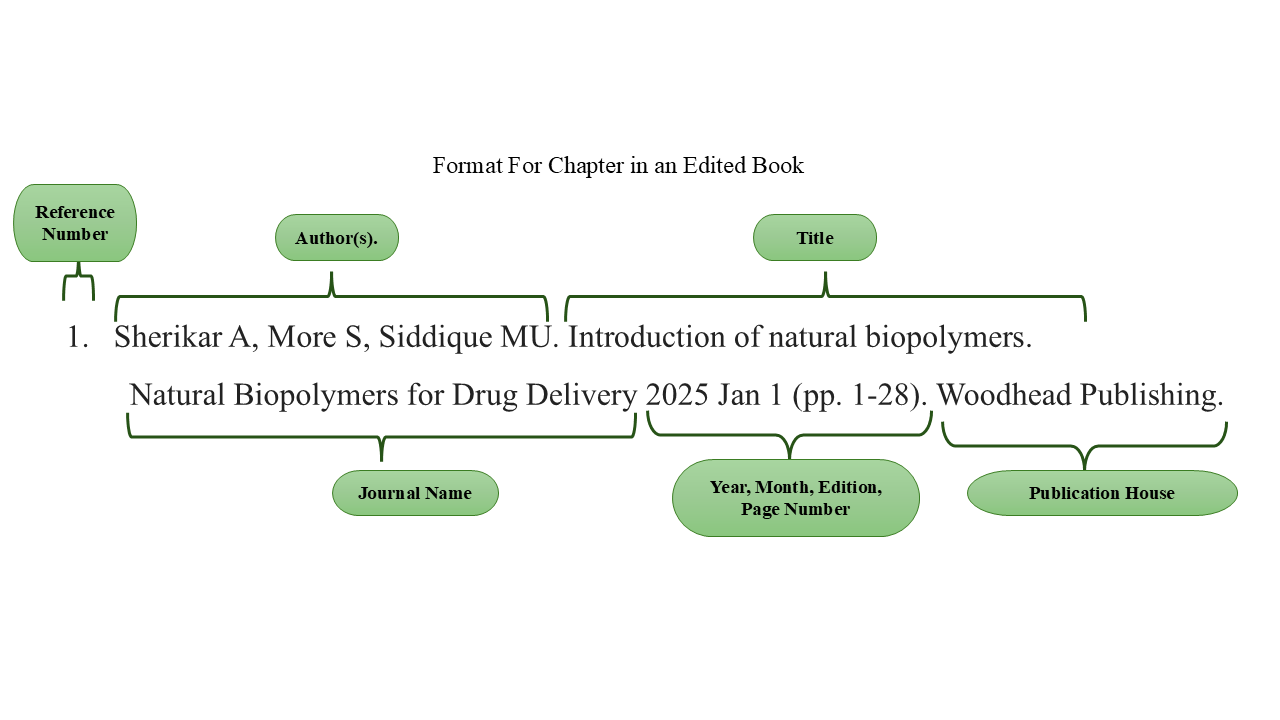
References should be listed in Vancouver style. Preferred reference management tools include Zotero, Mendeley, and EndNote.
1. Format for Journal Article

2. Format for Books
5. Figures & Tables
- Quality Requirements:
Figures must have a minimum resolution of 300 dpi (dots per inch) to ensure clarity and high-quality print.
Tables should be created in an editable Word format to allow for easy modification during the review process.
All figures and tables should be of sufficient quality and should not be pixelated or blurry when printed.
- File Formats:
Figures should be submitted in common formats such as PNG, JPEG, TIFF, or EPS.
Avoid submitting PowerPoint slides or low-resolution images.
- Size and Dimensions:
Figures should be sized appropriately for publication.
Ideally, they should be clear and legible at reduced sizes.
Tables should be formatted to fit within the page layout and should not be excessively large.
- Citations in Text:
Every figure and table must be cited in the manuscript text
Example in text: "As shown in Figure 1, the results indicate a significant trend."Tables and figures should be referred to as Figure 1, Table 1, etc., and must be numbered consecutively.
- Captions:
Figures: Include a descriptive caption that provides enough detail to understand the figure without referring to the main text.
Tables: Include a descriptive title above the table that explains its content.
Captions should be brief but informative. Avoid lengthy descriptions but ensure all necessary information is conveyed.
- Alignment and Placement:
Ensure that figures and tables are aligned with the text and do not disrupt the flow of the content.
Tables should be centered on the page, and figures should be placed appropriately within the text, preferably near their first mention.
- Referencing Figures & Tables:
Figures and tables should never be included in the appendix unless specifically requested.
Make sure figures and tables are numbered sequentially based on their appearance in the manuscript (e.g., Figure 1, Figure 2, etc.).
- Ethics and Permissions: If figures or tables are reproduced from another source, ensure that you have the appropriate permissions and that the source is properly cited.
- Text in Figures & Tables: Text included in figures and tables should be clear and readable. Use standard fonts and avoid overly small font sizes.
Label the axes of graphs clearly and include units of measurement where applicable.
6. Copyright and License
Upon acceptance, authors will be required to sign a copyright agreement. Authors retain the copyright of their work and grant Helix Journal the right of first publication.
The journal operates under the Creative Commons Attribution 4.0 International License (CC BY 4.0). This license allows others to share and adapt the published work for any purpose, including commercial use, provided the original author and source are properly cited.
Authors must ensure that all figures, tables, or materials taken from other sources have appropriate permissions for reuse. A license statement will be included in the published article to indicate its open access status.
7. Article Processing Charges (APC)
Helix Journal is committed to promoting open and equitable access to scientific knowledge. Currently, there are no submission, publication charges, or hidden charges for authors. The publication process is entirely free of cost.
If Article Processing Charges (APCs) are introduced in the future, authors will be notified well in advance. Clear information about the fees, payment procedures, and any available waivers or discounts will be published on the journal’s website.
8. Peer Review Process
All manuscripts submitted to Helix Journal undergo a rigorous double-blind peer review process. In this model, both the authors and reviewers remain anonymous to ensure impartial and unbiased evaluation.
For a detailed explanation of our peer review process, please visit the Peer Review page.
First Editorial Decisions (2-3 days) may include acceptance, minor/major revision requests, or rejection. Authors will receive constructive feedback to help improve the quality of their work. The typical review timeline is 10-12 days, though this may vary based on reviewer availability.